1. My Arrest, Trial, and Nine Days in a Death Cell
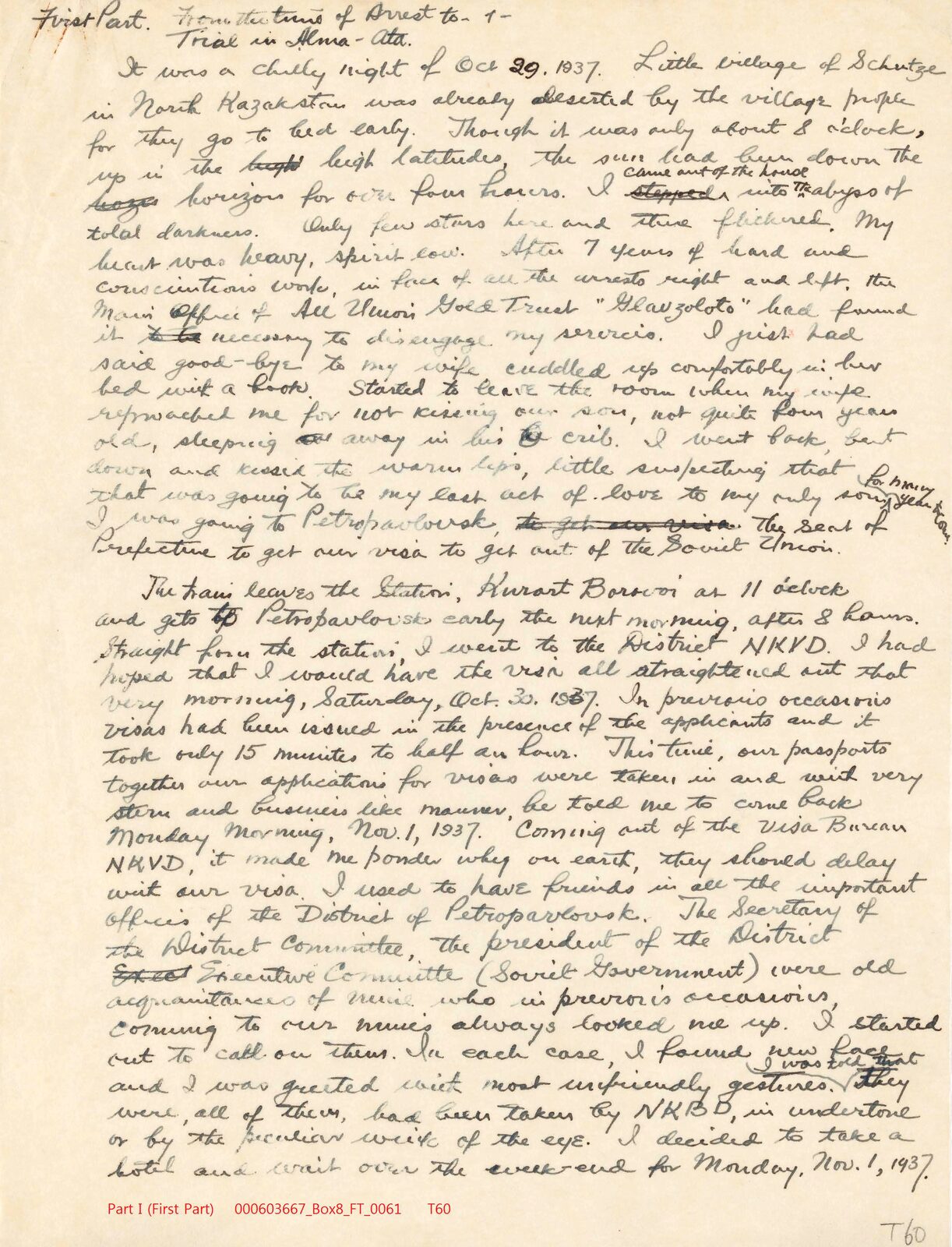
It was the chilly night of October 29, 1937. The little village of Shchuchinsk in North Kazakhstan was already deserted by the village people for they go to bed early. Though it was only about 8 o’clock, up in the high latitudes, the sun had been down the horizon for over four hours. I came out of the house into the abyss of total darkness. Only a few stars here and there flickered. My heart was heavy, sprit low. After seven years of hard and conscientious work in the face of all the arrests right and left, the main office of All Union Gold Trust “Glavzoloto” had found it necessary to disengage my services. I just had said good-bye to my wife cuddled up comfortably in her bed with a book. I started to leave the room when my wife reproached me for not kissing our son, not quite four years old, sleeping away in his crib. I went back bent down and kissed the warm lips, little suspecting that that was going to be my last act of love to my only son for many years to come. I was going to Petropavlovsk, the seat of the Prefecture, to get our visa to get out of the Soviet Union.
The train left the Station, Kurort Borovoi at 11 o’clock and got to Petropavlovsk early the next morning, after eight hours. Straight from the station, I went to the District NKVD.1 I had hoped that I would have the visa all straightened out that very morning, Saturday, October 30, 1937. On previous occasions visas had been issued in the presence of the applicants and it took only 15 minutes to half an hour. This time, our passports together with our application for visas were taken in and with a very stern and business-like manner, he told me to come back Monday morning, November 1, 1937. Coming out of the Visa Bureau of the NKVD, it made me ponder why on Earth they should delay with our visa. I used to have friends in all the important offices of the District of Petropavlovsk. The Secretary of the District Committee, the president of the District Executive Committee (of the Soviet Government) were old acquaintances of mine who on previous occasions, when coming to our mines, always looked me up. I started out to call on them. In each case, I found a new face and I was greeted with most unfriendly gestures. I was told that all of them had been taken by NKVD, in undertones or by a peculiar wink of the eye. I decided to get a hotel and wait over the weekend for Monday, November 1, 1937.
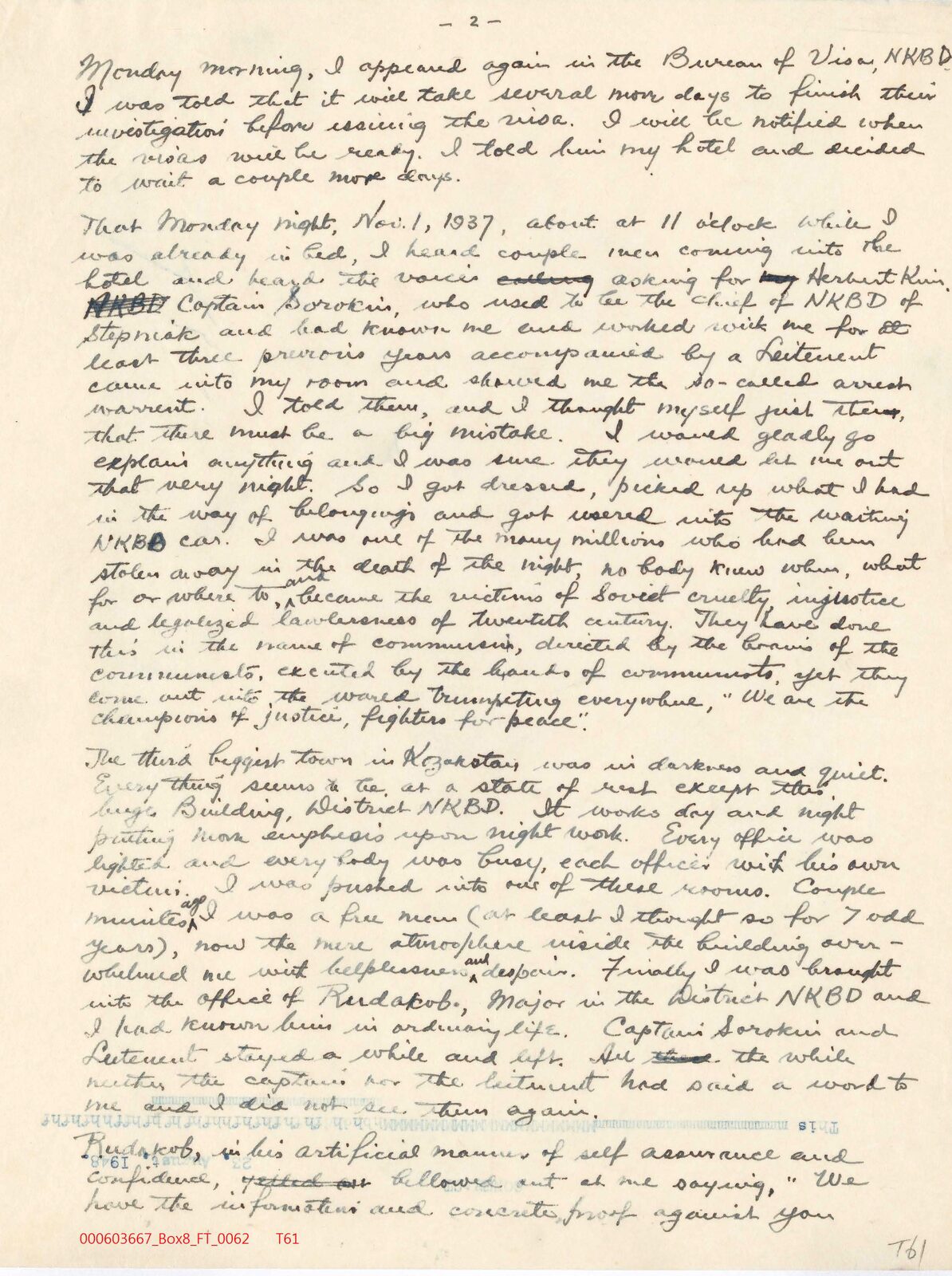
On Monday morning, I appeared again in the Visa Bureau of the NKVD. I was told that it will take several more days to finish their investigation before issuing the visa. I will be notified when the visas will be ready. I told him my hotel and decided to wait a couple more days.
That Monday night, November 1, 1937, at about 11 o’clock while I was already in bed, I heard couple men coming into the hotel and heard the voices asking for Herbert Kim. Captain Sorokin, who used to be the chief of NKVD of Stepniak and had known me and worked with me for at least three previous years accompanied by a Lieutenant came into my room and showed me the so-called arrest warrant. I told them, and I thought myself just then, that there must be a big mistake. I would gladly go explain anything and I was sure they would let me out that very night. So I got dressed, picked up what I had in the way of belongings and got ushered into the waiting NKVD car. I was one of the many millions who had been stolen away in the dead of the night, nobody knew when, what for, or where to, and became victims of Soviet cruelty, injustice and legalized lawlessness of the twentieth century. They have done this in the name of communism, directed by the brains of the communists, executed by the hands of communists. Yet they come out into the world trumpeting everywhere, “We are the champions of justice, fighters for peace.”
The third biggest town in Kazakhstan was in darkness and quiet. Everything seemed to be at a state of rest except this huge building, District NKVD. It works day and night, putting more emphasis upon night work. Every office was lit and everybody was busy, each office with its own victim. I was pushed into one of these rooms. A couple minutes ago I was a free man (at least as I thought for seven odd years), now the atmosphere inside the building overwhelmed me with helplessness and despair. Finally, I was brought into the office of Rudakob, Major in the District NKVD, whom I had known in ordinary life. Captain Sorokin and the Lieutenant stayed a while and left. All the while neither the captain nor the lieutenant had said a word to me and I did not see them again.
Rudakob, in his artificial manner of self assurance and confidence, bellowed out at me saying, “We have the information and concrete proof against you. You are a member of the counter-revolutionary group. In fact, you had come into the Soviet Union in 1930 as a foreign agent to pass out the search information concerning the Soviet Government. You have been working hand in hand with the counter-revolutionary group in the country in spying, sabotage and wrecking activities.”
I was dumb-founded. Had I not worked all through these seven long years, putting up with all the work I had to do to increase the production of gold? Had I not been responsible to bring Valarian Mine from the age-old hand drilling method of driving development work into the modern method of machine drilling? Wasn’t it through me that they had brought in heavy type English-made drills and later additional shipments of Chicago Pneumatic Drills, increasing the speed of advancement in drifts from 20 meters to 72 a month? Wasn’t it I who had put Shaft International into steady daily production of 300–350 tons of ore, and enabled it to reach its quota of 1000 kg of gold in 1933? Had I not been instrumental in getting five shafts developed for production in Dzelambet? In all, had I not taken the vital part in increasing the production of gold of Stepniak from about 230 kg in 1930 to about 7000 kg in 1937?
“As we know best that was only camouflage. You have to tell us about your real self. Nobody got out of this place without doing what we want him to do. You will write out your confession, consisting of this:
1. By whom were you first recruited into the counter-revolutionary group?
2. Where and under what circumstances?
3. What counter-revolutionary activities were you engaged in?
4. Whom did you recruit into the counter-revoluntary group?”
I laughed for I didn’t know what was coming to me. I told Rudakov that he might do anything he wished but he could get nothing out of me for I wasn’t guilty of any of the above-mentioned charges! He said, “That is what we hear from everybody when they first come in, but you will think differently when you will have stayed in jail for some time.” Then I was ordered out of his room and turned over to the prison warden. Rough handling started from that moment. Belts and even the shoe strings were taken off me. My loose leaf notebook, which never had left me for over ten years, and my pocket watch were taken away from me. By now, it was about 2 o’clock Nov. 2, 1937.
I was led out of the warden’s room. Opening a door which divides the two worlds, one Heaven in Hell where you may see the sunlight, books, office furniture, and most of all passers-by through the investigator’s windows; the other, hell on earth where once fallen, one is absolutely lost out of sight from his friends and enemy alike. This side of the door was the prison of Petropavlovsk NKVD.
The dim light of the corridors hardly shows the face of the other man close by. Dark figures of prison wardens moved up and down the gloomy hallway, now stopping in front of this and then that cell to look through the peep holes. No. 72 was designated to me and I was stopped and a door was opened with a click and clank of the heavy iron latch and bar.
Startled by this unexpected intrusion, the two other occupants of Cell No. 72 sat up in their beds to greet the newcomer. I was taken aback by the ghostly sight of these two occupants but already the door slammed behind me. Getting accustomed to the dim light, I began to perceive things, most of all the expression on their faces.
I was naive, dumb and stupid. I held myself aloof the other two. Why, I was absolutely an innocent man and by some sort of mistake I was taken into this place. Surely things will get explained and I will be set free. I could perceive this expression of pity and understanding. Sympathy? They had some but they had been in prison too long to really show any of it. They said they had felt exactly the same way as I did when they first got arrested. Occupant No. 1 was an Austrian, a war prisoner of World War I. He became a war prisoner in 1917 and had been sent to Siberia. While there, he met the October Revolution and, taking the side of the Bolsheviks, he fought the forces of Kolchak,2 and later the Japanese. For his services with the Bolsheviks, he had been hailed and welcomed and became a member of the Communist Party. He was very active in the collectivization program. Becoming a war prisoner when he was only in early twenties, he had married a Russian and settled down as a good devoted Soviet “Kolxoznik.”3 Yet in October 1936, the NKVD came and took him from his country home away from his Russian wife and children and now he was held for the 13th month.
The other cellmate was a Galician. He had crossed over the border in 1933 to find a better place to live. He was not a talkative man. He had been in prison for seven months and was charged with espionage. Both of them were finished with their investigation and I was informed of the following from these cell mates.
Ghostly looking, they were. They were nothing but bones and skin with overgrown hair and whiskers. They said that they were not hoping anything else but to have enough bread to satisfy their hunger even for once. “Our only wish is that we will soon be taken out of this prison and be sent to prison labor camps where we may see the sun, breathe the fresh air and most of all have more food. When we were first arrested, we thought exactly the same as you did. We were innocent. We did nothing wrong against the Soviet Union. In the name of justice, we may protest. They may do anything to us but we could never admit anything we are not guilty of. But they do not stop at anything to get what they want from us. They won’t let you sleep for weeks at a time. They don’t give you enough to eat. If you do not give in the first time, they keep on doing it the second, third, fourth — until you do what they want.”
Listening to what they had to say, I said to myself, “You might have done what they wanted, but I will never do it. I will die before I will do what they want me to.” Then I thought of my wife and child. “What if they do something to them. If only they get out of Russia, out of the reach of this outlawry, I will die in peace.”
They wanted to know the news from the outside world! But what could I tell them? This purge has been going on for the last year and half but in the outside world, people are totally ignorant of it. Innocent people give very little thought to what is going on in the way of clearing the country of the counter-revolutionists, foreign agents and the enemies of the people. The papers are so well-controlled and played up with the purge that nobody dares to think that any innocent man may get hooked in. If he thought of it, he dares not to express it even to himself for fear that he might be overheard. Innocent men never think that they will get arrested and therefore show no interest. So and so was arrested by NKVD. Well he was a nice man, but it must be he is guilty. Outside of that, everything seemed as usual. All I could tell them were the names of nationally and locally-prominent men who had been mysteriously disappeared. One hour in this cell made me understand more mysteries than in all the years I had lived in Soviet Union!
The cell was about ten feet by six feet, and a small window with iron bars and an outside hood barely showed a little piece of sky. Two wooden decks big enough for a man to lie on fixed and leaning on the opposite walls may be let down upon the stools to sleep on during the sleeping hours. When these decks were swung up to the wall, the stools may be used by two occupants. The third arrival had to stay down on the floor. I must have been tired for I was awakened at six o’clock by the yelling of the warden. A cupful of water is given for inmates of the cell to wash. A tin can is given to a cell to be used for a toilet. There, at seven o’clock, the happiest hour for the inmates is when each gets a hunk of black bread. For most of them it wakes up the appetite but never satisfies. I couldn’t eat a morsel of the bread. I broke the eatable hunk of bread into two and gave each to my cellmates. Their expression of gladness for having the additional bread stays in my memory to this day.
This sharing of bread went on for about two weeks, with shares diminishing each day until finally I found the ration was not enough for myself. From then on, one day was very much the same as the other one. They had kept me in the cell for a whole month without calling me. Much thinking had gone through my head each day bringing me a sense of the hopelessness of my case.
The so-called investigation started just one month after my arrest. By this time, I was beginning to feel the hunger and getting morally depressed. I was dying to know what became of my wife and son. The investigation consisted of getting me into a chair in a room with a guard. The only thing the investigator says is to write down my confession. I say, “I have nothing to confess.” Then I was kept on sitting, with my investigators changing in three shifts. Thus I was made to sit up day and night without sleep for a week at a stretch. At the end of the week, they let me go back to my cell with the warning that, in my second investigation which will follow soon, if I refused to do what was told of me, then they had to issue the order to arrest my wife, and put my son into the orphanage.
It was just like a thunderbolt struck my head. All this while, against my reasoning, I had hoped that Pauline with our son had made her way out of the Soviet Union. Now, I could see that they were not going to let my wife and son out of the country. For a whole month, they did not call me again. In the middle of January, I was called, and this time they were determined to squeeze out of me what they wanted. For ten days, I sat there and absolutely refused to write anything. They had written an arrest warrant for Pauline. I gave in, I gave in on condition that they tear up the arrest warrant and never touch my wife. They promised. I was sent back to my cell for rest. It was in the beginning of February that I started to write what they wanted me to write, each page was written again and again for I could never write to suit their taste. Then they would type-write with all the corrections they wanted to make and then I would sign my name on each page. I became bona-fide counter-revolutionist, wrecker, saboteur and an international spy! But how do I know if my wife is still outside, free? I was to receive every two weeks some kinds of parcel from her. The first one was a pair of underwear and that was right after I started to write. The next one was my winter overcoat and fur cap. Then for fully two months, I did not receive anything and I thought she was arrested too!
Some time in April 1938 I was called out with my belongings from my cell where I had been living for the last six months. I was transfered into a big cell where all the inmates had completed their investigation. Here the food is the same as before but the prison regime is not supposed to be as strict as the smaller cells. By this time I was so run down physically that five minutes of daily walk allocated to each cell could not be taken advantage of and I had to stay in the cell most of the time. The names of some of the inmates still remain in my memory and they are Gaosikov—Sergin—Muntyan—Izoomov, Kacheganov—Gidrim—Okonenko—and a few others, representing five different nationalities.
The big cell was facing the yard for the daily walks of the inmates. Although the windows are closely covered up with wooden boards, as the boards get dry some cracks have invariably come into existence through which the cellmates got their biggest delight to identify faces from other cells of people taking their daily walks. One day, watching through these cracks as usual, one of my cellmates recognized a woman walking to be my wife. For weeks, I had been tortured by the idea that I was coerced into the so-called confession. After all, they had taken my wife into the prison. But about a month after that, in May, I had my last package of summer clothing and some home-made cookies and that was the last of the news I received from my wife. It was a great relief to know that she was still outside, free but why on earth doesn’t she get out of Soviet Russia?
I might add here, that taken totally away from outside world and getting a thread of news by receiving something, no matter how small that it may be, used to be the greatest joy to a prisoner. A little morsel of food shared at the time of receiving such a parcel carries an unusual significance. There we were, 10 or 15 people not knowing the fate in store for us. Passing month after month of hungry days, most of us still hoped that some kind of miracle will happen and the political situation in the country might change, and a general amnesty of all the political prisoners may come! Many of us had been sold on the idea that the Soviet Government cannot bring these people before a trial on such made up and fictitious charges after all. The thing we may expect will be that each one of us will be notified of the decisions by “Troika”4 in Moscow of being sentenced to three, five, or ten years in prison camps.
On December 1, 1938, exactly 13 months after my arrest, most of us from that cell were called out and hurriedly put into the prison truck and sent out to the R.R. station and loaded into the prison coaches in Petropavlovsk. Traveling on the Soviet Railway over a long distance in third or fourth class, one will find that the coaches are divided into sections crosswise, almost like compartments. Along one side of the coach is the long corridor. In these sections are two benches facing each other accommodating six people sitting face to face during the day and only two sleeping at night. Above them are a second pair of benches used only for sleeping. The third story benches are used for shelves for baggage. In these sections, where ordinarily 6 people are being accommodated, they had fitted with iron bars and doors to which they cram into between 18 and 26 prisoners. On top of that, they let you out to tend to your natural functions only twice in 24 hours. To get an idea how we traveled in these cars, open up a can of sardines and take off the flat cover and look into the can to see how the sardines are packed with their heads and tails alternately, then one will get the exact idea how we prisoners in Soviet Russia accommodated ourselves.
Yes, but we didn’t know where we were being taken to! We prisoners in one cage said to ourselves, “If the train pulls out toward the east, we were being sent to Kolima, the gold mines opposite Alaska. If toward the west, we were being sent to Volgastroi.”5 It was rumored that prisoners were mostly sent to these two prison camps and sentences were read to them after they were taken to the camps! That night the train pulled out and toward the east. But when it got to Novosibersk, the train went southward and on December 6, 1938 we were put into prison in Alma-Ata. Why we were taken down to Alma-Ata we didn’t know until a couple of days later.
On December 9, 1938, at about 10 o’clock at night I was called out of Alma-Ata Prison with all my belongings and put into a windowless black prison truck. I didn’t know where I was being taken. The truck pulled up to some place and I was ushered down from the black truck into a closely-guarded big building, very brightly lit. There were many vacant rooms. In each of these rooms three mats were prepared, and on each mat, a prisoner was made to lie down. Beginning from about 11 o’clock that night (December 9, 1938) til about 1 o’clock in the afternoon of the next day, I was made to lay there not knowing what was coming to me.
About 1 o’clock December 10, 1938, I was called out from my lying posture and two guards, one walking in front and the other walking in the back of me, led me to a room. An imposing sight was disclosed to me as soon as I stepped into the room. Five military officers with rhombics6 and other high insignia were sitting in a row in front of me. On my left side (as I stood facing them) was another uniformed man who later on I learned to be a prosecutor, and on my right another man in military uniform. I was made to stand at attention, one guard on each side of me. They all arose and said that in the name of the Military Collegium of the Supreme Court of the U.S.S.R.,7 the trial was open. The Judge standing in the center asked my name, date of birth, nationality and finally asked me if I admitted the guilt or not. The whole procedure didn’t last more than three minutes. Then the guard ordered me to walk out of the courtroom and kept me all alone in a vacant room for about 15 minutes. I was called into the courtroom again. This time only five judges came in and, standing, they pronounced the sentence: “To be shot.”
The guard ordered me to walk out again and I automatically followed his command. When I heard the sentence, it was as though I had been hit by a club and I didn’t quite believe my ears. Straightaway I was taken over to a cell and, opening the big door, I was pushed into the cell. Already, there were four more ahead of me who were sentenced to be shot. Every ten minutes, the cell was opened again, a new one was pushed in, also with the same sentence, until the final number got to be eleven. All these eleven were foreigners and, before talking about or thinking about our death sentence, some of us were more interested in the pailful of porrhage the prison warden forget to take away from us all when they prepared this cell for eleven of us. It wasn’t even a pailful but some porrhage was left in the bottom of the pail. That was how hungry we were!
The eleven inmates sentenced to be shot were:
Petko, a Bulgarian, worked in the Bulgarian Communist Party and was being sent to Soviet Union to be trained. He had been married to a Russian girl and was going to a political course in Alma-Ata.
Herbert Kim, came into Russia in 1930 as one of the American Mining Engineers.
Tass, a German, speaking perfect Russian. He was about 45 years of age and his parents immigrated into Russia for business.
Myers, a German and an electrical engineer. Had come to Russia in 1933.
Reites, an Austrian engineer.
Wolf, a German worker, came to Russia in 1933 or 1934.
Melxiov, an Austrian engineer.
Ridder, an Austrian worker.
Chelmak, a Czechoslovakian engineer.
Kodim, a Czechoslovakian worker.
Worm, an Austrian worker.
Of these eleven people, three of us, Petko, Tass and I, suffered the most. The rest of them didn’t seem to think much about our fate. As for myself, I fell asleep the first night after I got the death sentence. However, the next morning, I couldn’t get up from my bed. My limbs wouldn’t move. Besides, they were aching just as though malaria fever was coming over me. My first thought was, “Where is my wife and where is my son? If they, by any means of providence have gone out of Russia, they will find the means to live, but what if they are still in Russia?” Then comes the thought that I had been educated and trained to do some useful work and at 33 years of age, I was going to be killed on charges I was absolutely innocent of! All day I was a sick man. So were Petko and Tass, and we were like that for about three consecutive days. Then, the days went on, very slowly, for nine days waiting every minute of each day to be called out and be executed.
On the ninth day, on December 19, 1938, the door of the cell suddenly opened and everybody in the cell was caught with fear and anxiety. One of the cellmates, Worm, was taken out. Everybody thought that the time had finally come. Dead silence reigned. Everybody looked at each other with bewilderment and despair. Five long minutes passed and the door opened again, Worm was pushed in, and Chelmak was the second one to be taken out. Worm’s face was as white as a white sheet of paper. He couldn’t speak. Between his breaths, he whispered, “25 years.” Yes, the death sentence had been changed into 25 years imprisonment. The effect of his announcement was different for different individuals. Some were glad. Others, indifferent. Still others felt that death sentence would have been much better than 25 years imprisonment. My reaction was that of gladness. 25 years is a long time and many changes will come about if only I will not be shot to death right thus! But will they change the sentence for me too? I wanted to find out as soon as I could. I pushed myself in front, closest to the door so when the door opens again, I will get out next! Soon the door opened, Chelmak came in, and I went out and followed the prison guard to a little room.
A captain of NKVD sat there, in front of him a table. On this table a bunch of papers were lying. There was a telegram which he showed me. The telegram was signed by Kalinin8 to the effect that all 11 of us, listed name by name, were to be pardoned from the death sentence but to be charged with 25 years of imprisonment. So the wholesale arrest, sentence, slaughter, or pardon went on, at the will and the command of a few in power.
By prison code of knocking on the wall of the cell, we had gotten the response of the joining cell, having the same death sentence as we eleven of us had. They were foreigners too, but we never did find out what became of them. In Alma-Ata alone, for the first ten days in December 1938, during the session of the Military Court from Moscow, they had given verdicts to over 800 prisoners, all of them death sentences. (Exact figures not verified). Of these 800, how many got the good luck of having their death sentences changed into 25 years? Working ten hours every day, the military court must have handed out one death sentence every six minutes to put through over 800 people! They certainly gained their time on me for it didn’t take more than three minutes!
The NKVD (People’s Commissariat for Internal Affairs), the Soviet secret police, carried out the arrests of the Great Purge and administered the prison and labor-camp system.↩︎ Back to text
Admiral Alexander Kolchak led the White (anti-Bolshevik) forces in Siberia during the Russian Civil War.↩︎ Back to text
Kolkhoznik: a member of a kolkhoz, a Soviet collective farm.↩︎ Back to text
Troikas were three-member NKVD panels that passed sentence without trial, defense, or the defendant’s presence.↩︎ Back to text
Kolyma, in far northeastern Siberia, was the most notorious complex of Gulag gold-mining camps; Volgostroy was the forced-labor construction project building dams on the upper Volga.↩︎ Back to text
Rhombics: the diamond-shaped collar insignia that marked the highest Soviet military and security ranks before shoulder boards were reintroduced in 1943.↩︎ Back to text
The Military Collegium of the USSR Supreme Court pronounced sentence on the regime’s most prominent purge victims, often in sessions lasting only minutes.↩︎ Back to text
Mikhail Kalinin, the Soviet Union’s titular head of state, whose office handled clemency decisions.↩︎ Back to text